 Loading


Theorizing and Enacting Societal Impact - 3 ECTS
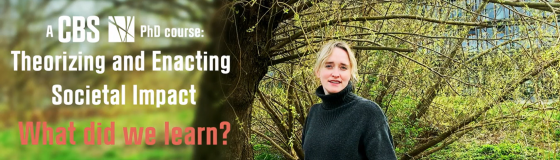
Course Coordinator: Eva Boxenbaum, Professor
Department of Organization, CBS
Faculty
Eva Boxenbaum, Professor
Department of Organization, CBS
Pedro Monteiro, Tenure-Track Assistant Professor
Department of Organization, CBS
Anders Krabbe, Tenure-Track Assistant Professor
Department of Strategy and Innovation, CBS
Professor Susanne Boch Waldorff
Department of Organization, CBS
Vivi Lena Andersen, Director
Rudersdal Museums. PhD Cup 2018 participant
Cathrine la Cour, documentarist/ journalist
Outreach Now
Marianna Lubanski
Project Lead & Change Agent for Innovation & Impact
Copenhagen School of Entrepreneurship, CBS
Prerequisite
Participants are required to submit an individual project plan related to societal impact (1-2 pages) no later than Nov. 15. They must attend the full course to obtain a course certificate.
The relationship between research and society is evolving rapidly. As scholars, we are encouraged to conduct research that contributes to society beyond offering new theoretical, methodological, and empirical insights. We are increasingly incentivized to articulate and demonstrate the societal impact of our research beyond our scholarly community and the classroom. Socially meaningful research is becoming a parameter for access to research funding and new pathways for research-based innovation and entrepreneurship are opening.
This course equips participants with a theoretical understanding of societal impact that can help them make their own research socially impactful. Participants learn about professional organization and acquire organizational and communicative insights that are useful for enhancing the societal impact of research. Through this work, they begin shaping their own professional identity and impactful pathway in view of crafting a meaningful career.
Content
The course is composed of theoretically informed lectures on societal impact at the intersection of organizational theory and communication theory. The morning blocks (“theorizing impact”) focus on understanding the inter-organizational context, using organizational theory. In the afternoon blocks (“enacting impact”), participants learn to navigate this context as an individual scholar, based on communication theory and entrepreneurship.
Lecture plan
Tuesday Dec. 1
Theorizing impact
9.00 – 10.00: Introduction to the course (Eva Boxenbaum)
10.30 – 12.00: Professional aspirations (Anders Krabbe)
Enacting impact
13.00 – 16.00: Audiovisual storytelling & academia (Cathrine la Cour
16.00 – 16.30: Feedback
Wednesday Dec. 2
Theorizing impact
9.00 – 10.15: Changing roles and expertise of scholars (Pedro Monteiro)
10.45 – 12.00: Translating research to impact public policy (Susanne Boch Waldorff)
Enacting impact
13.00 – 16.00: Verbal and non-verbal communication skills (Vivi Lena Andersen)
16.00 – 16.30: Feedback
Thursday, Dec 3
Theorizing impact
9.00 – 10.15 Modes of communication (Eva Boxenbaum & Silviya Svejenova)
10.45 – 12:00 Art & Aesthetics (Silviya Svejenova)
Enacting impact
13.00 – 15.00: Entrepreneurial pitching & pathways (Marianna Lubanski)
15.00 – 15.30: Feedback
15.30 – 16.00: Course evaluation
Teaching style
The pedagogical approach revolves around an application of theoretical insights, step by step, to gradually build a product that aims at fostering societal impact of the participants’ research. Participants gain insights from lectures, discussion, group work, and exercises as the course unfolds.
Participants learn to analyze the professional context in which they operate, using theoretical insights from organization and management research. They are also encouraged to position themselves within this context and apply insights from communication theory to present their research effectively to a broader audience.
Abbott, A. (1981). Status and status strain in the professions. American Journal of Sociology, 86(4), 819-835.
Benco, R. C. (2020). Why science needs art. Smithsonian Magazine (April 15, 2020). https://www.smithsonianmag.com/blogs/national-museum-of-natural-history/2020/04/15/why-science-needs-art/
Boxenbaum, E., Jones, C., Meyer, R., & Svejenova, S. (2018). Towards an articulation of the material and visual turn in organization studies. Organization Studies, 39(5-6), 597-616. https://doi.org/10.1177/0170840618772611
Huising, R., “Epistemic travel and its dangers: Academic impact seeking, influencing, and posing” in preparation for Research in the Sociology of Organizations.
Jones, C., Svejenova, S., Pedersen, J. S., & Townley, B. (2016). Misfits, mavericks and mainstreams: Drivers of innovation in the creative industries. Organization Studies, 37(6), 751-768.
Kacprzyk, J., Clune, S., Clark, C., & Kane, A. (2023). Making a greener planet: nature documentaries promote plant awareness, Annals of Botany, 131(2), 255–260.
Khoury, C. K., Kisel, Y., Kantar, M., Barber, E., Ricciardi, V., Klirs, C., ... & Novy, A. (2019). Science–graphic art partnerships to increase research impact. Communications Biology, 2(1), 295.
Krabbe, A. D., & Grodal, S. “The mediation dilemma and power hybris in the hearing aid industry (1945-2015)”, working paper.
Li, N., Villanueva, I. I., Jilk, T., Van Matre, B. R., & Brossard, D. (2023). Artistic representations of data can help bridge the US political divide over climate change. Communications Earth & Environment, 4(1), 195.
McKee, R., & Fryer, B. (2003). Storytelling that moves people. Harvard Business Review, 81(6), 51-55.
Meyer, R. E., Jancsary, D., Höllerer, M. A., & Boxenbaum, E. (2018). The role of verbal and visual text in the process of institutionalization. Academy of Management Review, 43(3), 392-418.
Reinecke, J., Boxenbaum, E., & Gehman, J. (2022). Impactful Theory: Pathways to Mattering. Organization Theory, 3(4). https://doi.org/10.1177/26317877221131061
Vaughan, D. (2006). NASA revisited: Theory, analogy, and public sociology. American Journal of Sociology, 112(2), 353-393.
Villanueva, I. I., Li, N., Jilk, T., Renner, J., Van Matre, B. R., & Brossard, D. (2024). When science meets art on Instagram: Examining the effects of visual art on emotions, interest, and social media engagement. Science Communication, https://doi.org/10.1177/10755470241228279
Course Diploma
The binding registration deadline is 15 October 2026. If you wish to cancel your registration, you must do so by this date. After the deadline, we will assess whether there are sufficient registrations to run the course and, if necessary, allocate seats if demand exceeds capacity.
If seats remain available after this deadline, the registration period may be extended to fill the remaining seats.
Please note that once you receive our acceptance or welcome letter, your registration becomes binding, and no refunds of the course fee will be issued.
Information about the Event
Date and time Tuesday 1 December 2026 at 09:00 to Thursday 3 December 2026 at 16:30
Registration Deadline Thursday 22 October 2026 at 23:55
Location
Kilen - room KL4.74 (fourth floor)
Kilevej 14A
Frederiksberg
DK-2000
Organizer
Nina Iversen, CBS PhD School
Phone +45 3815 2475
ni.research@cbs.dk
Event Location
About CBS PhD School
Copenhagen Business School (CBS) offers a range of PhD courses, covering the scientific disciplines of the school. The courses include research design, publication techniques, research methods such as qualitative or quantitative methods, and specialisation courses in eg. organisational analysis, marketing and political science.
Most courses are organised as intensive week-long courses, but other formats are applied as well. The courses are open to PhD students from other countries and institutions, but some prerequisites may apply. Please see the individual course descriptions.
The PhD courses are offered in English and are for PhD students only.
Registration

Loading
Registration
Loading
Loading
Loading
Info About the Main Attendee
Fields marked with a (Required) must be filled out.
Event Location
About CBS PhD School
Copenhagen Business School (CBS) offers a range of PhD courses, covering the scientific disciplines of the school. The courses include research design, publication techniques, research methods such as qualitative or quantitative methods, and specialisation courses in eg. organisational analysis, marketing and political science.
Most courses are organised as intensive week-long courses, but other formats are applied as well. The courses are open to PhD students from other countries and institutions, but some prerequisites may apply. Please see the individual course descriptions.
The PhD courses are offered in English and are for PhD students only.