 Loading


Macro Organizational Theories - 4 ECTS
Course coordinator: Julia Bodner, Department of Strategy and Innovation (SI), CBS
Faculty
Professor Nicolai Foss
Department of Strategy and Innovation (SI), CBS
Professor Thomas Rønde
Department of Strategy and Innovation (SI), CBS
Tenure Track Assistant Professor Anders Krabbe
Department of Strategy and Innovation (SI), CBS
Professor MSO Kristina Dahlin
Department of Strategy and Innovation (SI), CBS
Prerequisites
No specific prerequisites are required.
Because the course is comparative, one question runs through every session: how does each theory connect to the others? Where do they complement, overlap with, or contradict one another? We keep returning to this mapping question in discussion and in the memos, and a good way to prepare is to read each session’s set with that question in mind.
Course Objective and Overview
This seminar introduces the main macro organizational and management theories, and how they are used in management research. It is a foundational course on theories that explain firms and organizations, with the aim is to build a broad, comparative map of the field. Students learn to see how the major theories relate to, build on, and contradict one another, to build a solid basis from which to develop their own work.
Why do firms exist at all? Why do they behave as they do, and why do some succeed while others fail, some come to resemble one another while others stay distinct, and some survive while others disappear? Different traditions answer these questions from different starting points. Over eight sessions, we work through economically grounded theories of the firm (property rights, transaction cost economics, agency theory), behavioral and cognitive perspectives, resource-, knowledge-, and attention-based views, the economics of competition, and a set of sociological theories of organization (institutional, evolutionary, contingency, network, population-ecology, resource-dependence, and organizational-learning perspectives).
The course is intended as a starting point that lays the foundation for management and organizational theory. The aim is threefold: (i) to map the major theories and surface the connections among them; (ii) to engage current debates about each theory’s explanatory power and limits; and (iii) to strengthen students’ ability to put these theories to work in their own theoretical development.
Learning Objectives
On successful completion of this seminar, students will be able to:
- Map the major theories of the firm and organization, and articulate each theory’s core assumptions, causal mechanisms, units and levels of analysis, and central predictions.
- Critically evaluate and compare theoretical and empirical contributions within and across these perspectives.
- Identify gaps, tensions, and dualities across theories and translate them into researchable questions.
- Apply a theoretical lens to a specific empirical context or phenomenon.
- Develop and communicate an original theoretical contribution in writing.
Course Format and Expectations
The seminar consists of eight discussion-oriented sessions, each led by a session anchor. The class prioritizes discussion for students’ learning and understanding—students should not expect to receive a summary or to simply be presented with the faculty's perspectives.
All students are expected to read every required reading for every session and to come to class ready to discuss it. To foster the discussion, students should expect to be engaged by faculty and asked to explain their understanding of the readings and to raise the questions they left them with.
Each session has a set of discussion questions. These questions structure both the pre-class memos and the in-class discussion.
Literature
A detailed reading list will be provided closer to the start of the course. Students should expect 3 to 4 readings for each session.
As preparation and for later reflection on the content of the course, Scott and Davis “Organizations and Organizing” is recommended.
On what counts as theory. Sutton, R. I., & Staw, B. M. 1995. What theory is not. Administrative Science Quarterly, 40(3): 371–384. Please read this article before Session 1; it is the touchstone for the final paper and for our discussions of theoretical contribution throughout the course (references, data, lists of variables, diagrams, and hypotheses are not, by themselves, theory).
Assignments and Evaluation
Session memos (one per session)
For each session, students will write a short memo of at most two pages (single-spaced). The memo is not a summary, and it should not be about a single reading: its job is to tie the session’s readings together. Treat them as a set and work across them in light of the session’s discussion questions — what each one contributes and to which conversation; where they build on, complement, or contradict each other; what assumptions they share or dispute; and how convincing their arguments and evidence are.
Each memo must end with a brief, explicitly outlined idea: either (a) a gap or unresolved tension you see in the session’s literature, or (b) a sketch of how a specific empirical context or phenomenon could be examined through the session’s theoretical lens. A few sentences are enough — the point is to practice turning a body of theory into a researchable question.
Memos are due 24 hours before the session, are circulated to the whole class, constitute the memo component of the grade, and feed directly into class discussion.
Class participation
Active, prepared participation in every session is expected (but not explicitly graded). Students should contribute their thoughts and develop their understanding by integrating readings, testing assumptions, drawing comparisons across theories, and posing new questions.
Final paper: a theoretical “front end”
The seminar is completed by an individual paper that develops an original theoretical contribution. The paper should be built like the front end of a journal article: a tightly framed Introduction and a Theory section that together develop the contribution. Choose a topic that interests you and match it with one of the theories covered in the seminar — ideally something connected to your own dissertation work.
There are several legitimate forms the paper can take. You may develop a propositional, Academy of Management Review–style theory paper; reframe or extend an existing theory; bring two theories into productive tension; or critically examine the problems of empirically testing a theory. In all cases, the paper should make a clear theoretical point.
Length: minimum 10 pages (single-spaced, excluding references, tables, and figures).
Grade allocation
The grade will be on a scale and composed by the following on a standard Danish grading scale:
- Session memos 50%
- Final paper 50%
Note that while we grade memos and the final paper as one grade, students can select the option to have only a pass/fail reported on their course diploma.
Maximum number of participants: 15. If registrations exceed capacity, CBS PhD students have first priority; remaining seats are filled on a first-come, first-served basis.
Course Schedule
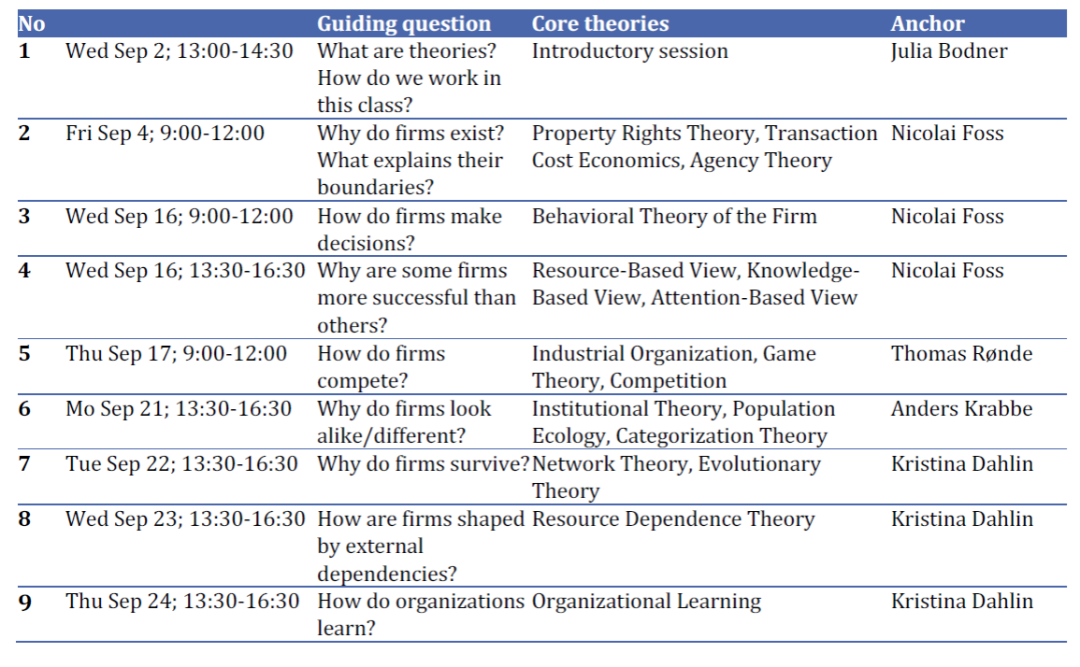
Weeks 38 and 39. Session theories and anchors are summarized below; detailed readings and discussion questions follow closer to the start date.
Introductory Session 1 will be held online on September 2 and will be 90 min long. Sessions 2 to 9 will be 3 hours long each and be held in person.
Registration Deadline and Conditions
The registration deadline is 30 August 2026. If you wish to cancel your registration, it must be done by this date. By this deadline, we determine whether there are enough registrations to run the course or decide who should be offered a seat if we have received too many registrations.
Information about the Event
Date and time Wednesday 2 September 2026 at 09:00 to Thursday 24 September 2026 at 15:00
Registration Deadline Sunday 30 August 2026 at 23:55
Location
Kilen - room KL 3.75 (third floor)
Kilen 14A
Frederiksberg
DK-2000
Organizer
Nina Iversen, CBS PhD School
Phone +45 3815 2475
ni.research@cbs.dk
Event Location

About CBS PhD School
Copenhagen Business School (CBS) offers a range of PhD courses, covering the scientific disciplines of the school. The courses include research design, publication techniques, research methods such as qualitative or quantitative methods, and specialisation courses in eg. organisational analysis, marketing and political science.
Most courses are organised as intensive week-long courses, but other formats are applied as well. The courses are open to PhD students from other countries and institutions, but some prerequisites may apply. Please see the individual course descriptions.
The PhD courses are offered in English and are for PhD students only.
Registration

Loading
Registration
Loading
Loading
Loading
Info About the Main Attendee
Fields marked with a (Required) must be filled out.
Event Location
About CBS PhD School
Copenhagen Business School (CBS) offers a range of PhD courses, covering the scientific disciplines of the school. The courses include research design, publication techniques, research methods such as qualitative or quantitative methods, and specialisation courses in eg. organisational analysis, marketing and political science.
Most courses are organised as intensive week-long courses, but other formats are applied as well. The courses are open to PhD students from other countries and institutions, but some prerequisites may apply. Please see the individual course descriptions.
The PhD courses are offered in English and are for PhD students only.